Below you will find pages that utilize the taxonomy term “Economic”
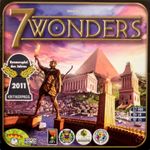
7 Wonders
7 Wonders You are the leader of one of the 7 great cities of the Ancient World. Gather resources, develop commercial routes, and affirm your military supremacy. Build your city and erect an architectural wonder which will transcend future times.7 Wonders lasts three ages. In each age, players receive seven cards from a particular deck, choose one of those cards, then pass the remainder to an adjacent player. Players reveal their cards simultaneously, paying resources if needed or collecting resources or interacting with other players in various ways.
read more
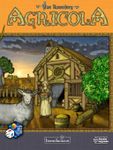
Agricola
Agricola Description from BoardgameNewsIn Agricola, you’re a farmer in a wooden shack with your spouse and little else. On a turn, you get to take only two actions, one for you and one for the spouse, from all the possibilities you’ll find on a farm: collecting clay, wood, or stone; building fences; and so on. You might think about having kids in order to get more work accomplished, but first you need to expand your house.
read more
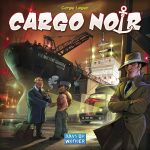
Cargo Noir
Cargo Noir In Serge Laget’s Cargo Noir – his fourth standalone box game from Days of Wonder – players represent "families" that traffic in smuggled goods in a 1950s noir setting. Each turn, you’ll set sail to various ports where cargo is known to get "lost" for the right price – Hong Kong, Bombay, Rotterdam, New York and more – and you’ll make an offer for the goods on display. If another family then offers more in that port, you’ll need to up your bid or take your money and slink away to look for goods elsewhere.
read more
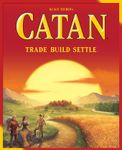
CATAN
CATAN In CATAN (formerly The Settlers of Catan), players try to be the dominant force on the island of Catan by building settlements, cities, and roads. On each turn dice are rolled to determine what resources the island produces. Players build by spending resources (sheep, wheat, wood, brick and ore) that are depicted by these resource cards; each land type, with the exception of the unproductive desert, produces a specific resource: hills produce brick, forests produce wood, mountains produce ore, fields produce wheat, and pastures produce sheep.
read more
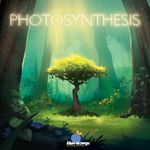
Photosynthesis
Photosynthesis The sun shines brightly on the canopy of the forest, and the trees use this wonderful energy to grow and develop their beautiful foliage. Sow your crops wisely and the shadows of your growing trees could slow your opponents down, but don’t forget that the sun revolves around the forest. Welcome to the world of Photosynthesis, the green strategy board game!
read more
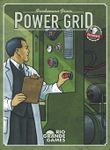
Power Grid
Power Grid Power Grid is the updated release of the Friedemann Friese crayon game Funkenschlag. It removes the crayon aspect from network building in the original edition, while retaining the fluctuating commodities market like Crude: The Oil Game and an auction round intensity reminiscent of The Princes of Florence.The objective of Power Grid is to supply the most cities with power when someone’s network gains a predetermined size. In this new edition, players mark pre-existing routes between cities for connection, and then bid against each other to purchase the power plants that they use to power their cities.
read more
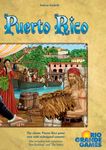
Puerto Rico
Puerto Rico This deluxe game of Puerto Rico began as Puerto Rico: Anniversary Edition, a tenth anniversary edition of Andreas Seyfarth’s Puerto Rico that celebrates Puerto Rico’s debut at Spiel 2001 with a production-ready copy that met mass acclaim.Game play is the same as the original Puerto Rico game: The players are plantation owners in the days when ships had sails. By growing up to five different kind of crops – corn, indigo, sugar, tobacco, and coffee – they try to run their business more efficiently than their close competitors: growing crops and storing them efficiently, developing San Juan with useful buildings, deploying their colonists to best effect, selling crops at the right time, and, most importantly, shipping their goods back to Europe for maximum benefit.
read more
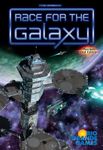
Race for the Galaxy
Race for the Galaxy 2018 UPDATE: The second edition of the game is improved for CVD (color blindness) and includes 5 revised cards from the original version and 6 New Worlds promo homeworlds. The promo homeworlds and first edition compatible Revised Cards are both available for purchase through the BGG store.In the card game Race for the Galaxy, players build galactic civilizations by playing game cards in front of them that represent worlds or technical and social developments.
read more
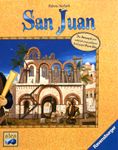
San Juan
San Juan San Juan is a card game based on Puerto Rico. The deck of 110 cards consists of production buildings (indigo, sugar, tobacco, coffee, and silver) and "violet" buildings that grant special powers or extra victory points. Cards from the hand can be either built or used as money to build something else; cards from the deck are used to represent goods produced by the production buildings, in which case they are left face-down.
read more

Splendor
Splendor Splendor is a game of chip-collecting and card development. Players are merchants of the Renaissance trying to buy gem mines, means of transportation, shops—all in order to acquire the most prestige points. If you’re wealthy enough, you might even receive a visit from a noble at some point, which of course will further increase your prestige.On your turn, you may (1) collect chips (gems), or (2) buy and build a card, or (3) reserve one card.
read more
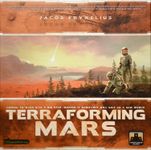
Terraforming Mars
Terraforming Mars In the 2400s, mankind begins to terraform the planet Mars. Giant corporations, sponsored by the World Government on Earth, initiate huge projects to raise the temperature, the oxygen level, and the ocean coverage until the environment is habitable. In Terraforming Mars, you play one of those corporations and work together in the terraforming process, but compete for getting victory points that are awarded not only for your contribution to the terraforming, but also for advancing human infrastructure throughout the solar system, and doing other commendable things.
read more
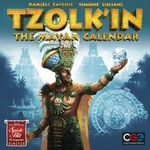
Tzolk'in: The Mayan Calendar
Tzolk’in: The Mayan Calendar Tzolkin: The Mayan Calendar presents a new game mechanism: dynamic worker placement. Players representing different Mayan tribes place their workers on giant connected gears, and as the gears rotate they take the workers to different action spots.During a turn, players can either (a) place one or more workers on the lowest visible spot of the gears or (b) pick up one or more workers. When placing workers, they must pay corn, which is used as a currency in the game.
read more